In brief
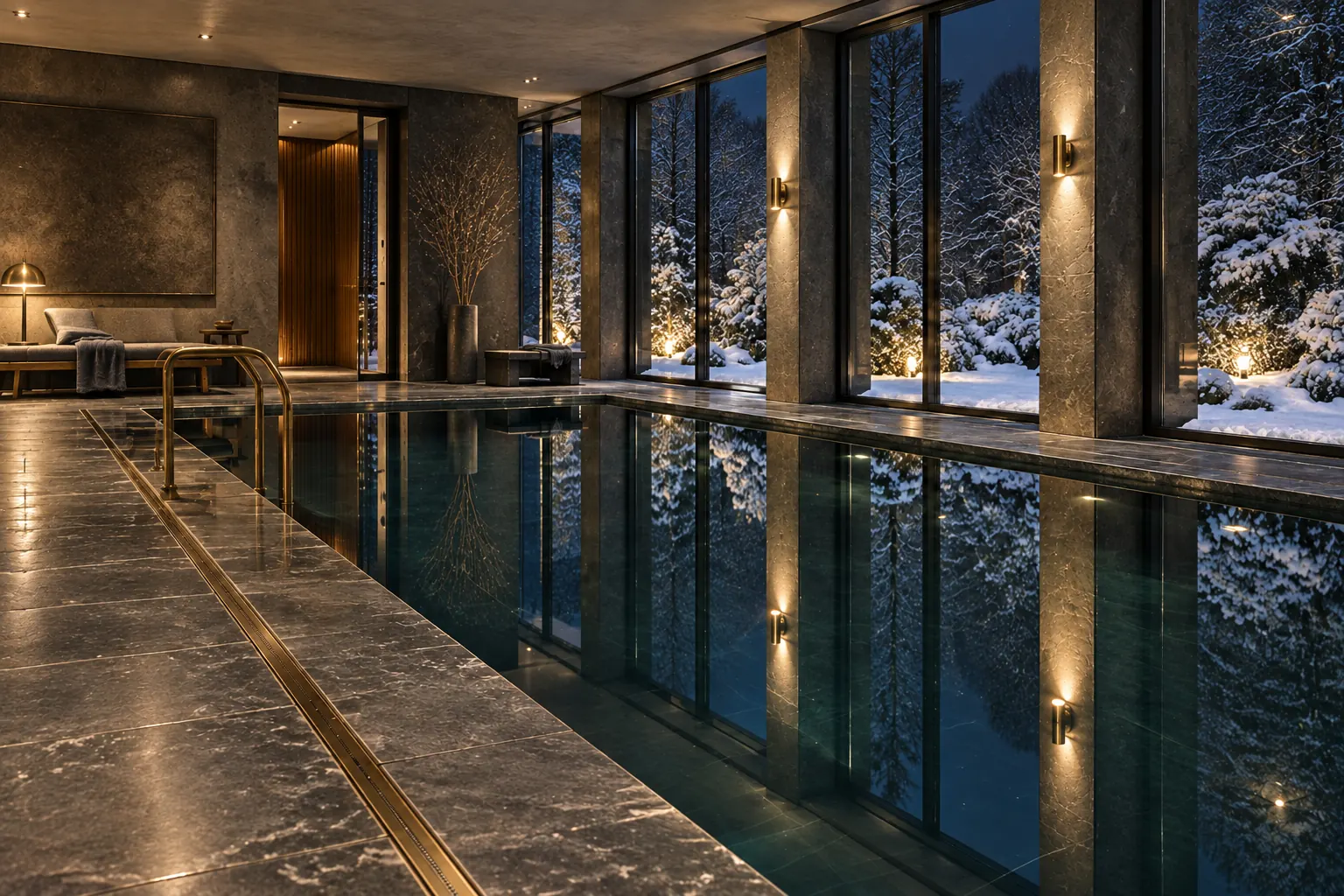
Whether an indoor pool is pleasant to live with, day to day, is decided by the building services, not the basin. Once the structure holds the water, the thing that never stops begins: the air around the pool. Warm water gives off moisture day and night, and how you handle that air decides whether the glass stays dry, whether the room smells of chlorine, and whether after a few years there is no corrosion or damp in the walls. The climate of the pool hall — the moisture balance, ventilation with dehumidification, protecting the glazing from the dew point, and heat recovery — is designed together with the architecture, because it drives the duct cross-sections, the floor height and the room for the plant. Cuts made at this stage come back later: as fogged glass, a smell of chlorine, corrosion. And there is a question worth asking before all the others: is a year-round covered hall really what you want.
The basin is the simplest part
Groundwater, uplift and the watertightness of the basin itself — the whole structural side of a pool on the lowest floor — I have written about separately, in the piece on a pool on a high water table. That is hard work, but once it is done well it no longer needs daily attention. For years afterwards that part does not behave the way the services do — at most you keep an eye on the details: the seals, the finishes, the drains.
The climate of the hall is the opposite. It runs all the time. The surface of the warm water gives off moisture without pause, and the air has to have somewhere to take that moisture. Whether it is pleasant inside is settled not in the basin but in the air around it — and it is settled on paper, before the architect fixes the floor heights and before anyone chooses the equipment. So an indoor pool is not “a pool, only under a roof.” It is a separate room with a climate of its own, and it has to be designed for that climate from the first line.
The moisture balance — everything hangs on it
Everything in a pool hall starts with one figure: how much water evaporates off the surface in an hour. That is not a curiosity — the whole ventilation design follows from it. The warmer the water and the drier the air in the hall, the more it evaporates, and it is not only the surface that evaporates but the wet surrounds, the splashed floor, the bodies of the people climbing out. That flow of moisture has to be calculated, because the duct cross-sections, the dehumidification capacity and the floor height all follow from it: the hall’s ducts need room under the ceiling, and if nobody worked that out before the height was fixed, there is too little space left for ducts, insulation and access.
I do not calculate the balance myself — that is the job of a pool ventilation designer, a specialisation of its own; the installer will not sort it out on the side. My job is different: give him real data on how the pool will be used — water temperature, surface area, whether it is covered, the hours of use, the glazing — leave room in the design for the ducts and the plant room, and not let anyone trim his assumptions down to nothing along the way. Because the moisture balance looks harmless on paper, and the whole comfort of the hall stands on it.
Water temperature and air temperature
Most of it comes down to the water temperature. It decides the comfort, and along with it the size of everything else: every degree of warmer water means more evaporation, more dehumidification and a bigger bill. That is why the air in the hall is kept 2 to 4 degrees warmer than the water. It is not a whim — wet skin coming out of the pool loses heat as the film of water on it evaporates, so warmer air keeps you from feeling cold and, at the same time, draws a little less moisture off the surface.
I learned this on my own, far simpler pool. In my previous house we had a pool in the garden; the first summer, with no heating, I got into it maybe twice all season, because the water simply would not warm up. The next year I put in heating and the difference in comfort was enormous — since then I cannot imagine a pool that is not heated. A covered hall in a residence is a completely different scale, year-round and under a roof, but the lesson is the same: the water temperature you choose decides the comfort, and right after it the size of everything that keeps that comfort. So when I hear “as warm as possible,” I say plainly that warmer water means bigger equipment and a higher running cost — and then it is your call.
The dew point, or why the glass is the weak spot
In a warm, humid room every surface colder than a certain point collects water on it. That point is the dew point, and the coldest surface in a pool hall is almost always the glass — and the frames around it. You know it from old windows: in winter water runs down a single pane while the wall right next to it stays dry. The glass is cold, so it is on the glass that the air gives up its moisture. In a pool hall the same thing happens, only all year round. If a surface regularly drops below the dew point, water will condense on it — often for long hours, especially in winter. And damp, warm, with chlorine in the air is exactly the condition in which fittings corrode and insulation in the wall grows wet.
The defence is to let no surface go cold. You warm the glass. That is why the warm supply air is run along the glazing: a stream sent over the water itself would only speed up evaporation, while one sent up the glass makes a warm curtain against it and helps hold its surface above the dew point — provided the glazing and the details are properly worked out. Because the air alone is not enough if the pane is cold and the frame makes a thermal bridge. The most common mistake I see is a simple one: glass all the way to the floor, beautiful, and no room beside it to run the supply air. On top of that the wall itself is designed for this one climate — with a vapour barrier sealed on the warm side, so that moisture does not get into the wall and condense somewhere inside where nobody will see it. I know this physics from ordinary house ventilation: when warm, humid air passes through a cold zone, it can start to condense inside the duct. In a pool hall the same physics is at work, only all year.
Better glass does not settle the matter on its own. Even good glazing in a pool hall can drop close to the dew point on the coldest nights — the point is to keep the surface with a margin above that line, and let the warm air along the glass help hold that margin on the coldest days. So the glass and the air are chosen together.
The energy that escapes as vapour
Here is the part few people expect. In an ordinary house the biggest consumer of energy is heating the rooms. In a pool hall it is not. Heating the volume itself is usually not the largest item. Most of it escapes through evaporation: every kilo of water that turns to vapour carries its warmth away and leaves the water in the basin a touch colder, and the heating has to make that up without pause. That loss runs around the clock, at night too, when nobody is swimming.
Picture a pot on the stove. With no lid it steams away endlessly and you keep feeding it heat to hold the temperature; put a lid on and it settles at once. An uncovered pool is like that pot without a lid, only switched on all the time. So the good systems do not simply throw that warm, humid air outside. A pool air-handling unit with a heat pump condenses the vapour out of it, takes the heat back and returns it to the water or to the incoming air. The energy that left the basin as vapour comes back into the loop. Not for free and not in full — but without that recovery there is no sense in running a year-round hall.
The real running cost comes down to five things, and it is worth knowing them, because each is a decision to make: how warm you keep the water, what humidity you hold in the hall (usually around 50–60 percent), whether the surface is covered when nobody is swimming, how good the heat recovery is, and how well the glass and walls hold heat. Four of those five are set at design stage. The fifth — covering the basin — is cheap and simple to run, and it counts for a surprising amount: a closed cover cuts evaporation right down and lets the equipment run at lower output and more quietly. So I ask about it early and plainly: will the basin be covered when no one is swimming? The answer changes the choice of equipment and the running cost of the whole system. I will not give you a figure — because until I know the water temperature, the glazing and whether there is a cover, it would be a guess.
Dehumidification, fresh air and the plant room
The climate of the hall is held by equipment that runs non-stop, at night too. The solutions fall into two families. The simpler are dehumidifiers working mostly on the hall’s own air in a closed loop — cheaper, enough for a small pool; the more developed ones can bring in some fresh air and recover heat, but they do not fully solve the fresh-air question. The second family is a full pool air-handling unit: it dehumidifies, exchanges the air for fresh, and recovers heat. In a residence, with a hall used all year and a large area of glass, the second one makes sense. The fresh air matters for a reason you will catch with your nose — it carries off the smell of chlorine. That smell is usually chloramines, the result of the water chemistry and too little ventilation at once; fresh air carries them off, but it does not replace good water treatment.
A good system adjusts to all this: full output when the pool is in use, throttled back at night, near idle when the basin is covered. It is the automation that keeps the equipment working at full only when it has to. The space for it, its service route and its distance from the bedrooms I described alongside the structure — here I will add just one thing, because it is something you feel: this equipment runs long hours, at night too, and a bedroom has a way of landing right above the plant room. So the plant room gets acoustic separation, and the units sit on anti-vibration mounts; otherwise the pump you cannot hear in the day can be heard at night and starts to bother you. And it is built with room to spare, because a pool unit is not a device for life — one day it gets replaced, and that replacement cannot mean opening up walls.
How you can tell the ventilation went wrong
Badly done climate does not report itself. You see it and smell it before anyone measures it. Glass that will not quite clear. A smell of chlorine right at the door. Fittings and parts starting to rust, marks under the ceiling. And the worst kind, the one you do not see: moisture that gets into the wall through a leaky vapour barrier or a badly resolved detail and condenses there — corroding steel and soaking insulation for years before anything shows.
Almost always the cause is the same: treating the pool hall like the rest of the house, only bigger. Household heat-recovery ventilation is not an active dehumidifier and is not built for constant moisture or for chlorine — hang the hall off it and the glass will tell you within the first season. The hall’s climate is its own system, independent of the house. The worst thing for any room is humid air standing still; here it must not be allowed to stand by accident — it has to be carried off deliberately, through ducts sized for this one purpose. I am not writing this to frighten anyone. Every one of these symptoms comes from the same place: the climate was tacked on at the end instead of being a starting assumption. Move it to the front and they do not happen.
When an indoor pool is not worth it
Before any of this is built, there is one honest question. A year-round covered hall is a commitment for years — equipment running every day and a climate that has to be held the whole year. It is worth it for someone who really will swim in winter too. But if the pool is in truth a summer pleasure, then an outdoor or seasonal one — or a separate, lighter building not tied into the structure and heating of the house — can give you the same joy without a daily climate to keep.
I do not say “don’t build it.” After we talk about how you will really use the pool, the question is how much hall you want to run, not whether it can be built. I lay out both roads with their consequences, and the decision stays with you.
There are also a few things I do not promise. An indoor pool will not be cheap to keep — the physics does not allow it. If someone promises otherwise, ask what they are leaving out. It will not be maintenance-free either; even good automation needs servicing and an eye kept on it. And I will not put a number on the running cost before the design tells me the water temperature, the glazing and whether there is a cover — before that it would be guesswork.
What I ask before I say yes
If you are considering an indoor pool, these questions will come up anyway. Better that they come up before the design:
- Is the hall’s climate — the moisture balance, ventilation with dehumidification — designed together with the architecture, or fitted afterwards to finished interiors?
- What is the water temperature meant to be — and is it understood that it sets the size and the cost of everything else?
- Are the glazing and its details calculated for the dew point — warm supply air along the glass, a vapour barrier on the warm side — or just chosen “because they look good”?
- Does the system have heat recovery and fresh-air exchange, or is it a dehumidifier working on a closed loop?
- Will the basin be covered when nobody is swimming? (it changes the choice of equipment and the running cost)
- Where is the plant room in relation to the bedrooms, and does it have room to spare for replacing the equipment later?
- Who calculates the moisture balance — and is there room in the design for the ducts under the ceiling?
This is the list I run through myself on every such project. If any of these questions has no answer, the design is not ready — however good it looks in the renderings. And questions about working with me, from budget to the pricing model, I answer in the Questions section.
Frequently asked questions
Does an indoor pool at home need its own ventilation?
Yes. The pool hall gets its own ventilation with dehumidification, independent of the household heat-recovery system — that one is not an active dehumidifier and is not built for constant moisture or chlorine. Without a separate system the moisture will find the coldest surface in the house and condense on it, for years and quietly.
Why does the glass in a pool hall fog up, and how do you prevent it?
Because the glass is the coldest surface in the room, and against a cold surface the air gives up its moisture most easily. You prevent it by running warm supply air along the glazing (a warm curtain) and designing the glass so its surface stays with a margin above the dew point. The glass and the ventilation are chosen together.
How much does it cost to run an indoor pool?
I will not give a figure before the design, because the cost is set by several things at once: the water temperature, the humidity, whether the surface is covered and how good the heat recovery is. Most of the energy escapes through evaporation off the surface, which is why heat recovery and covering the basin when nobody is swimming make the biggest difference to the bill.
Does an indoor pool always make sense?
No. If you will mostly swim in summer, an outdoor or seasonal pool can give you the same comfort without a year-round hall to keep. That is a calculation I show after we talk about how it will really be used — with the consequences of both roads, and the decision stays on your side.
If you are thinking about an indoor pool, bring the subject to me before the architect fixes the heights and the glazing — while the hall’s climate can still be designed, instead of rescued. Let’s talk about your project.